via MTmini
The above demo shows 1/2 of the ingredients of a "true" multi-touch display.
To make images appear under your fingers instead of over on the computer's screen, takes only a few more steps:
1) Remove the IR filter from the camera so it can detect infrared, then add a filter over the lens to ignore visible light, so the camera only "sees" IR.
2) Add an IR source inside the box, pointing up (many commercially available security cameras already come configured with IR "blast" arrays, or they can be purchased as a separate unit, or make your own).
3) Exchange the tracing paper for a material that is still translucent yet allows IR light thru.
4) Add a little LCD projector next to the camera in the box, also pointed up.
TaDa!
Now your hands will be bathed in invisible infrared light. As your fingers approach and/or touch the surface, the camera "sees" IR blobs, which are then processed in software to differentiate touch and other gestures. The "Touchlib" library includes everything you need to process the images (as seen in the video). Now you project the image up onto the touch surface from below. The image is projected in the visible spectrum and so doesn't interfere with the IR blobs being received by the camera.
There is also a way to get crisper IR blobs, without bathing the user's hands in IR, by using a technology called "Frustrated Total Internal Refraction" (FTIR), popularized by Jeff Han. FTIR relies on the unique properties of acrylic sheet, e.g. it is extremely reflective on the inside surface, until touched (or until it gets dirty). By shooting IR into the edges of the sheet, touches are "seen" by the IR camera whenever the internal refractive properties of the acrylic are "frustrated" by being touched. Each touch bounces a blob of IR down into the camera.
*
I've been having some great conversations about multi-touch lately. What constitutes multi-touch? Does dual-touch count? Can multi-touch be "faked" on a single-touch surface using close timing of events (e.g. milliseconds apart)? What if you use the same approach on a dual-touch surface? Is this how the iPhone works (e.g. software detection of finger-spacing)? What about the Macbook's dual-touch mousepad? How does that work, anyways? Which technologies are dominating, if any? Capacitive, grid o' wires, heat sensing, IR bath? Which approach is typically used for which commercial application?
9.02.2008
8.23.2008
8.15.2008
scalar
A little demo of 'scalar', triggered by a stribe. Scalar is written by vlad spears, of 'balron' fame. By changing simple things like the sensor poll rate, sticky or non-sticky values, MIDI scale, and instrument mappings, I am able to play the stribe in a variety of modes.
Of course the stribe strips can trigger a much higher resolution map than this (1024 potential points of resolution per strip). Though it doesn't demonstrate this unique aspect of the stribe, it's still fun to play with. The strips are much more sensitive than buttons, requiring the lightest touch. Rolling a finger on it's "ball" can produce a variety of subtle effects, a slide from one note to the next, or produce a very rapid 'fingered' pattern.
LED feedback is minimal at this point. Still working on the firmware...
stribe.org
scalar

8.06.2008
monome & stribe in the UK
A newly-constructed Stribe Prototype effecting simple single-voice sequences running on a Monome 40h.

7.26.2008
Tenebre

Tenebre - Platinum Standard
Interesting lo-fi-ish production and good playing on this instrumental track. The sound is stylistically reminiscent of Pavement, Sebadoh, and Slint, with a little dose of Elephant Six thrown in, and at the end some bells. More bells!
Thought food

Giant Alphanumeric Nixie Tube available for lots of $ on the 'bay

Sometimes I go to this page and just listen to the default sounds

A couple of 3-dimensional alphabets. Info on the above alphabet. The image below I came across randomly and I can't find any information about it, so let me know.

Another 3D alphabet

CNMAT's experimental spherical speaker

Interactive Acoustic Modeling from Princeton. video
7.25.2008
Max/MSP night school at CNMAT

Hallowed hall
Watch my ever-growing-in-detail blog post here: http://soundwidgets.com/smf/index.php?topic=204.msg741#msg741

Hangin' with the big kids
7.04.2008

5.31.2008
Tablo - conductive fabric gesture controller

Adrian Freed's "Tablo"
"As the conductive stretchable fabric... is displaced towards the bowl it shorts out different lengths of ...conductive plastic... The result is a circular array of nearly mass-less displacement sensors. The gesture-to-displacement relationship changes according to distance from the center of the bowl..." read more
5.23.2008
A Bicycle Built for Two

Daisy.mp3
Original "Daisy" Song 1961
Max Mathews, John Kelly, and Carol Lochbaum
From a Wikipedia article on Max Matthews: "In 1961, Mathews arranged the well-known song Daisy Bell ("Daisy, daisy") for an uncanny performance by computer-synthesized human voice, using technology developed by John Kelly of Bell Laboratories and others. Arthur C. Clarke of 2001: A Space Odyssey fame was coincidentally visiting friend and colleague John Pierce at the Bell Labs Murray Hill facility at the time of this remarkable speech synthesis demonstration and was so impressed that he used it in the climactic scene of his novel and screenplay for 2001: A Space Odyssey, where the HAL 9000 computer sings the same song as astronaut Dave Bowman disables his cognitive functions."
5.12.2008
Awesome Maker Faire 2008 video
So far this is the best Maker Faire 2008 summary I've seen - it captures the diversity of projects and amazing stuff quite well. Note however that even this great vid represents barely 1/10 of the actual amazingness to be found at this huge Faire.
Oh, and look for a brief shot of The Stribe at about 7:34. :)
From: curiousinventor.com
Oh, and look for a brief shot of The Stribe at about 7:34. :)
From: curiousinventor.com
5.11.2008
Cycling74 mentions Stribe, and Electronic Musician article
Cycling74 has a nice mention of the stribe and a pic re: Maker Faire 2008
Electronic Musician May 2008: DIY Resurgence by Scott Wilkinson
Electronic Musician May 2008: DIY Resurgence by Scott Wilkinson
5.06.2008

The Stribe booth at Maker Faire 2008
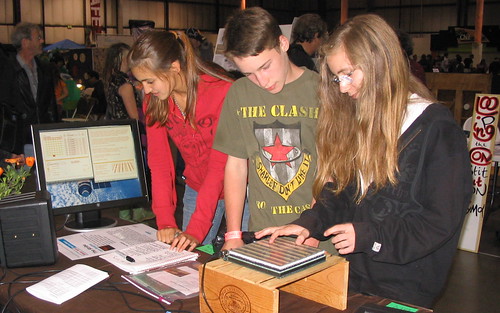
Some kids totally diggin' the way-out sounds
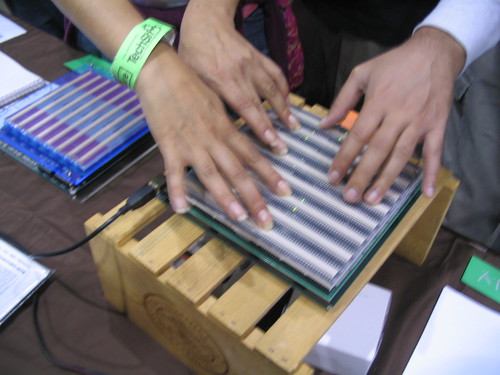
All hands on deck

Booth with stribe logo (made from construction paper)
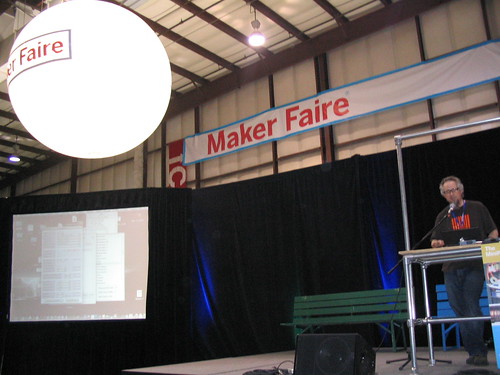
I gave a brief presentation about the Stribe - unfortunately I was completely unprepared and I had sound driver issues - better luck next time, I hope

Me (left) and Vlad (right), showing off the latest Stribe prototype
more: Flickr
5.04.2008
Maker Faire San Mateo, Day 1
Yesterday was the debut of the Stribe at Maker Faire, and it was amazing! A non-stop procession of fascinated people surrounded the booth for 10 straight hours. Stribe pioneer Vlad Spears totally saved the day when my MOTU interface gave up the ghost 2 hours into the demo. Just when I thought all was lost, Vlad stepped into the breach, fired up his own machine and held the crowd mesmerized with his lovely new Max 5 app, "Scalar", which made the Stribe into a wonderfully easy-to-play instrument. He manned the booth heroically and provided detailed explanations of the stribe, the monome, Max, and how it all fits together. I don't think he drank, ate, or sat down the whole time. My own demos pretty much relied on the MOTU, so without Scalar and Vlad it's hard to say what the day would have been like.
Thank You Vlad! You are a true rockstar, in every sense of the word.
I'm still a bit stunned at the level of interest and the many wonderful conversations I had with visitors and fellow Makers.
Today I hope to borrow an audio/MIDI interface from a fellow Maker and run some of my original demos, including a cool demo app written by stretta, along with a couple of my own creations.
Thanks to everyone who stopped by the booth on Day 1. I apologize if I didn't get to chat or you caught me in a flustered moment, but the onslaught of Make fans was unrelenting (which is really great) and I was overwhelmed at times. It was cool to meet members of the Stribe community in person, and I came away feeling both grateful and proud and just plain tickled. Something tells me this is going to be quite a ride. Thanks SO much for the enthusiasm and encouragement so far - it really does keep me going.
I have some great pictures and I'll post them as soon as I can. :)
Now it's time to get ready for Maker Faire, Day 2!
Thank You Vlad! You are a true rockstar, in every sense of the word.
I'm still a bit stunned at the level of interest and the many wonderful conversations I had with visitors and fellow Makers.
Today I hope to borrow an audio/MIDI interface from a fellow Maker and run some of my original demos, including a cool demo app written by stretta, along with a couple of my own creations.
Thanks to everyone who stopped by the booth on Day 1. I apologize if I didn't get to chat or you caught me in a flustered moment, but the onslaught of Make fans was unrelenting (which is really great) and I was overwhelmed at times. It was cool to meet members of the Stribe community in person, and I came away feeling both grateful and proud and just plain tickled. Something tells me this is going to be quite a ride. Thanks SO much for the enthusiasm and encouragement so far - it really does keep me going.
I have some great pictures and I'll post them as soon as I can. :)
Now it's time to get ready for Maker Faire, Day 2!
3.30.2008
stribe + MIDIbox = awesome app!!
From tk of midibox.org: "...Most of you guys are using Arduino based hardware, therefore I'm not sure if you are interested in an alternative approach, which is based on the MIDIbox hardware platform and MIOS. As the name implies, the focus is on MIDI communication instead of OSC via USB, accordingly this solution covers different usecases.
"The main difference to your current approach is the autarkic firmware, which doesn't require a computer to process the sensors, handle the LEDs, and to communicate with other MIDI devices. This might make it less flexible for experimental stuff, on the other hand I can easily add a LCD, buttons, more LEDs, rotary encoders, etc... - everything which is provided by MIOS - and control my MIDI synths directly..."
[more]
3.25.2008
red stribe wearing plexi
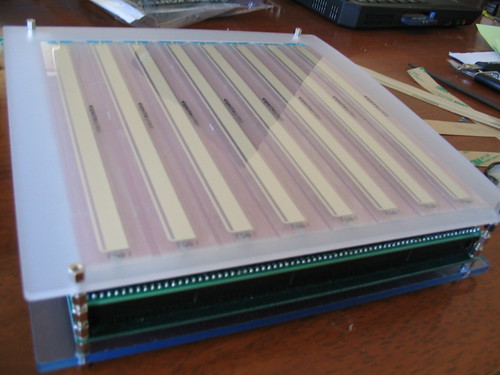
Some plexiglas test parts arrived from the Netherlands today via Xndr Industries. I assembled an all-red stribe with the new parts and it looks pretty awesome:
more pics here
3.22.2008
rockin the T-On
phineus + tenori-on + alesis micron from phineus on Vimeo.
I got a chance to play with a Tenori-On - it's pretty neat. Here I am testing out the MIDI implementation.
Subscribe to:
Posts (Atom)